vanshgrowth.com

Uncategorized

Uncategorized

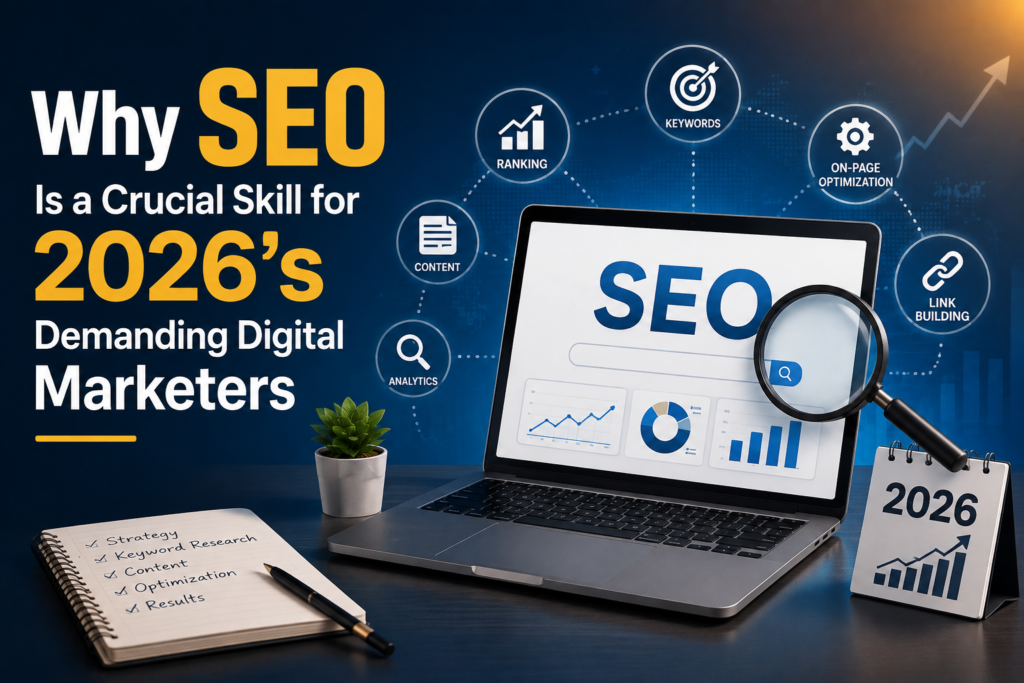
Why SEO Is a Crucial Skill for 2026’s Demanding Digital Marketers

/ SEO Training, Digital Marketing Course, Digital Marketing Training / By Akshit Rana Digital marketing has become an essential and vital practice for attracting customers, creating brand identity, and generating sales for many businesses today. To be able to operate effectively in the field of digital marketing in the coming years, he or she should have some digital marketing skills that would come in handy for him/her.  The most important skill to learn is SEO, or search engine optimization. This refers to getting websites indexed in search engines when someone searches for products or services on the internet. It is necessary to have SEO knowledge in 2026. Table of Contents What Is SEO and How Does It Work? Search engine optimization is called SEO. It entails the optimization of a website to enable search engines to understand what the website is all about. It also enables users to search for the required information. Some of the key components of SEO include: In a case where a user is searching for “digital marketing course near me,” search engines evaluate certain criteria in order to determine the relevance of the page to the search. Why is SEO important in Digital Marketing? The reason for SEO is that search engines are a crucial tool used by individuals when looking for businesses on the internet. The website can offer high-quality products or services; however, if people are not able to locate the website, then they have lost out on a golden chance. SEO can enable a business to: Key Advantages of SEO for Digital Marketers It is vital to be familiar with the benefits of search engine optimization for any company or digital marketer. 1. Generation of More Organic Visitors SEO allows you to generate more visitors to your site because of organic search results. The presence on the first pages of search results will help visitors to find your website without spending money on each visit. Getting an increased organic ranking means receiving constant traffic from individuals interested in what you offer. It also attracts those individuals who are looking for something similar to what you have. 2. Higher Visibility Online A proper search engine optimization strategy allows you to increase visibility online for relevant queries. Higher visibility means more chances for discovery by your future customers. If your website ranks for multiple keywords, your brand gets familiar to possible clients. This consistency will also help in building your brand awareness. 3. Customer Behavior Knowledge The process of SEO implies researching the queries used by people online. It is therefore possible for digital marketers to know what people want on the Internet. With the use of keyword research, it is possible for one to learn what the needs of the customers are. Such data can then be used by the company for marketing purposes. 4. Long-Term Marketing Advantage In contrast to marketing campaigns, which finish their effectiveness when funds run out, proper optimization allows attracting traffic even after its start.  If optimized content is the correct kind, then it can continuously bring traffic from the search engine for months or even years, as long as the content is kept up-to-date and relevant. Consequently, SEO becomes an effective investment, as it helps the company reduce dependency on paid advertisements. 5. Better user experience Nevertheless, the present-day SEO approach is not limited to keywords alone; it involves a user-friendly approach too, which includes website structure, mobile usability, navigation, page loading speed, and good content.  A user-friendly website prompts people to stay on it for a longer period of time and browse many pages on it. The user-friendly interface will help users engage more and also convert them into customers. Why Aspiring Digital Marketers Should Learn SEO It would be wise for those looking to enter the world of digital marketing to learn the importance of SEO. Some of the things that one learns from SEO include: Learning SEO will also be helpful in other marketing functions as well. For instance, writers can use SEO research to come up with articles on topics that people are searching for. Social media marketers can also use information about their audience to determine what the customers are interested in. That is why SEO is a very valuable skill for new digital marketers. The Working of SEO Marketing with Other Digital Marketing Channels  It is important to note that SEO marketing does not operate alone. It can complement various other digital marketing channels. SEO and Content Marketing Through the process of doing keyword research, digital marketers get to know what kind of information is being searched for online. Then, they use this information to create blogs, guides, landing pages, etc.  The practice of SEO can make sure that the content reaches the right kind of audience through the use of appropriate keywords and search intent. The content, which is SEO optimized, can also get organic traffic, provide answers to customers’ questions, and increase their confidence in the brand. SEO and Social Media Marketing Social media may help companies with content distribution and brand awareness. While activity on social media is not a direct ranking factor, it could help content get seen by more people. Distribution of optimized SEO content via social media increases visibility and makes the website more visible.  The social platforms will help the companies to gauge the interests of the audience and create content accordingly. SEO and Paid Advertising Both SEO and paid advertising can work together. While paid ads could ensure visibility, SEO ensures organic visibility in the long run.  Paid ads provide rapid traffic and leads, whereas SEO ensures that there is sustainable organic traffic. When used in conjunction with each other, paid ads and SEO can ensure that the business has a marketing strategy that is well-rounded. SEO and Web Development An optimized website is a great start for SEO. The task of the digital marketer will always be to collaborate with the developer and make the website better. The technical factors, such as the speed of loading the website,
Uncategorized

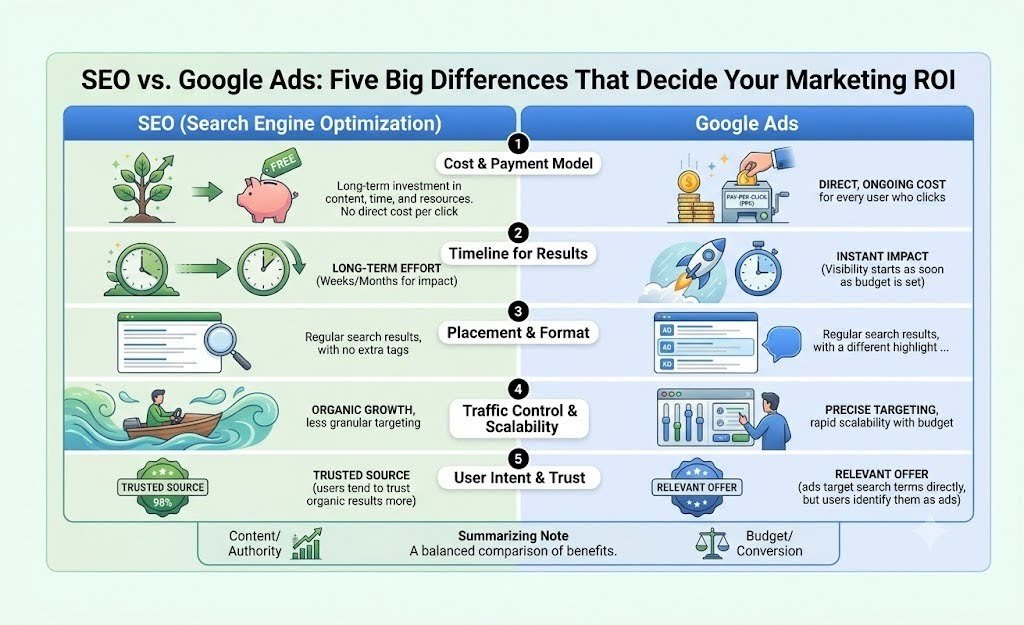
SEO vs. Google Ads: Five Big Differences That Decide Your Marketing ROI

/ SEO Training, Digital Marketing Training, Marketing Training / By Nizu Sachdeva Two strategies tend to be thrown into the ring when businesses are looking to boost their online visibility: SEO vs Google Ads. Both can be used to attract potential customers from the search engines, but in very different ways. In summary, SEO is long-term, and Google Ads is short-term.The decision isn’t just a matter of which is “better,” and there’s no definitive answer. The better question is, what strategy will get you the desired results in your time, budget, and business? The fact that there are differences between paid search and SEO helps you make better marketing decisions and boost your ROI. Table of Contents SEO vs. Google Ads: What’s the Difference?  Here are the five main distinctions between SEO and Google Ads quickly. Factor SEO Google Ads 1. Cost  Requires investing in content, optimization, technical SEO, and maintenance. The per-click advertising fee for organic clicks is not applicable. Implements a paid advertising platform; often users are paid for interacting with ads (e.g., clicking on them).  2. Speed Usually takes a long time to gain rankings and organic traffic. It can take weeks or months to get results, depending on competition and website authority.  Once approved and in motion, it can create targeted visibility and traffic much quicker. 3. Traffic &  Visibility Performs search engine optimization (SEO). Good rankings can help to drive traffic in the long term. Offers paid visibility in the search results in eligible auctions during the advertising campaign. 4. Control & Targeting Provides more indirect ranking opportunities since organic listings are based on search engine algorithms and ranking factors. Gives more control over budget, targeting, locations, keywords, schedules, ad copy, and landing pages 5. Long-Term ROI Can deliver high value in the long run, since an effective organic ranking can bring traffic without having to pay for each click. Can offer tangible ROI in the short term, but regular paid visibility usually requires regular advertising budgets. There are several key differences between SEO and Google Ads. 1. Cost: Organic investment vs. pay-per-click (PPC) One of the initial aspects businesses take into account while weighing SEO or Google Ads is cost. Usually, Google Ads will charge you for clicks or any interaction with the ads. This is influenced by various factors, including keyword competition, targeting, bidding strategy, ad quality, and campaign settings. The advertising expense determines the amount of paid traffic that can be generated; therefore, costs can escalate during the duration of the campaign. The cost of SEO is different. You don’t have to pay Google for every organic click. Rather, your money is spent on things like website optimization, technical SEO, keyword research, content creation, and website improvement and authority building. This does not mean that SEO is free. It takes time, expertise, and resources to do SEO professionally. Once a page reaches a high organic ranking, however, the extra traffic it receives is not an immediate cost to the advertiser for every click. That disparity is significant, especially when assessing long-term ROI. Google Ads can offer hard facts on how much is being spent and how many conversions are being achieved in the campaign. In contrast, SEO can build an organic traffic asset that will continue to generate revenue after the hard work is done. In summary, Google Ads needs to continue to be invested in to gain visibility through ads, whilst SEO needs to be invested in to achieve organic visibility. 2. Speed: Long-Term Growth vs. Immediate Results The most obvious difference between Google Ads and SEO is how fast you can get traffic on each of these strategies. With a good campaign set up and approved, Google Ads can begin to drive visibility right away. This is the reason paid search can prove to be useful for businesses that need immediate traffic, a new service they want to market, or a time-sensitive offer. The general rule is that SEO takes time to work—the search engines take time to find, evaluate, and index pages. There are various factors that influence results like website authority, content quality, competition, technical health, and search intent. Industry comparisons are often made by noting that PPC is quicker to get off the ground, whereas SEO results are mostly gradual. For instance, a company that is going to introduce a new service next month. Waiting for organic results could provide insufficient visibility before the launch. Meanwhile, while Google is developing its SEO strategy, Google Ads can help generate immediate exposure. That being said, SEO can have greater value if the business wants a consistent amount of organic traffic for the next couple of years. Takeaway: While Google Ads can bring immediate website traffic, SEO is more effective over the longer term to support your website’s organic growth. 3. Traffic and Visibility: Organic Rankings vs Paid Placement. The other important consideration in the SEO vs ads debate is where and how your site will rank in search results. When the campaign is qualified to display for a relevant query, Google Ads will prominently display the ads on search engine results pages. The targeting, budget, ad message, and landing page are under the control of the business. SEO works differently. The organic position of a page is determined by Google’s assessment of relevance, the quality of content, the user experience of a page, its authority, and so on. Organic visibility can be an important marketing asset in the longer term. Once you’ve optimized a page to rank for clicks that are relevant to your business, it can continue to generate traffic you don’t have to pay for. But SEO rankings do not come easily. Search algorithms, competitors, users’ behavior, and the layout of search results may vary. Organic visibility is not something that can be achieved in one go but needs continuous effort. The other drawback of Google Ads is that they must be paid for to be viewed, and ad performance leads to visibility. If a campaign is turned off or the budget is exhausted,

Uncategorized

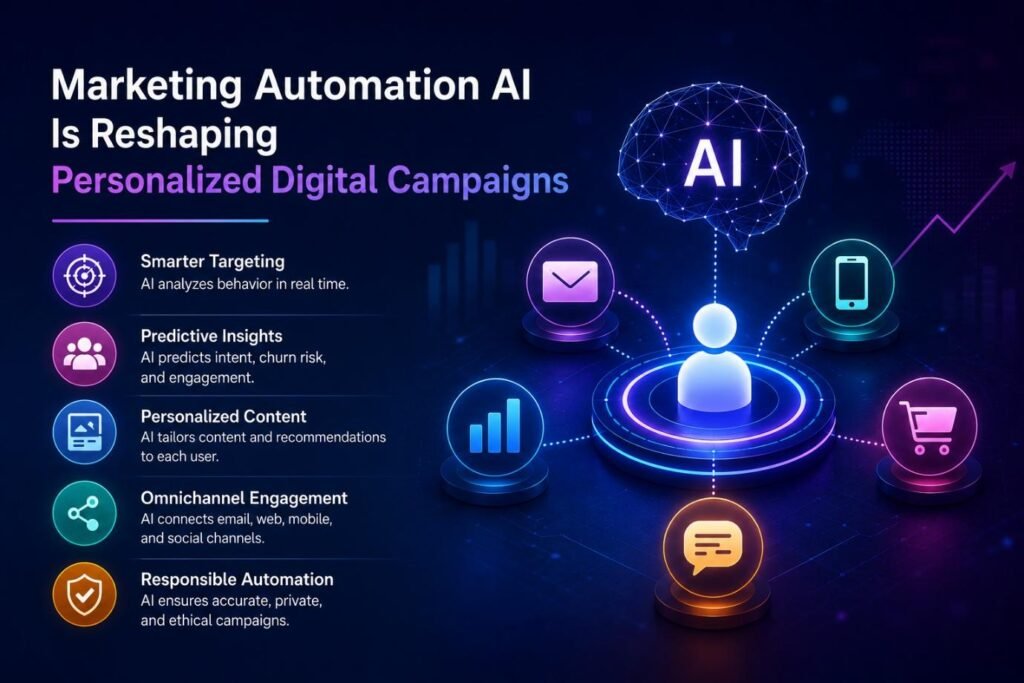
Marketing Automation AI Is Reshaping Personalized Digital Campaigns

Marketing Automation AI Is Reshaping Personalized Digital Campaigns / Marketing Automation / By Bodh Raj Today’s digital marketing campaign has the capability of reacting to events in the customer journey instead of following a fixed plan laid out days in advance. The fact that a product is seen twice, an email isn’t opened, purchase is finished, or a browsing pattern suddenly changes can impact the next message. The next communication in the campaign program can be adjusted and facilitated by AI technology used for marketing automation.  Technology has seen its success reflected in usage figures. As it has been shown in the survey of 4,450 marketing professionals conducted in 2026, 75% of them have already used AI technology, and 84% of them use conventional marketing methods.  Campaigns Are Getting More Responsive  Automated campaigns still run on simple rules. A customer does something, a predefined workflow sends an email at a chosen interval, such as 24 hours or 48 hours, and the communication is carried on. If these systems are useful when it comes to routine communication, they lack knowledge of what happens in between the triggers. AI changes the calculation. Instead of relying on one event, automated systems can assess several recent interactions before selecting a response. A visitor who repeatedly checks the same product but ignores promotional emails represents a different situation from someone who has just completed a purchase. The difference can show up in campaign results. Research published in 2025 recorded engagement and action rates roughly 10% higher for an AI-supported personalized telecom campaign than for a comparable non-personalized campaign. Content production is changing alongside targeting. Certain generative AI workflows have also been reported to accelerate content development by up to 50 times. Data Is Still the Difficult Part The technology may be capable of processing large amounts of information, but the information itself is often scattered. Customer service records, purchase histories, website activity, and marketing interactions may exist in separate systems. The main challenge for real-time personalization was discovered through research conducted with over 8,000 consumers and around 3,200 customer experience professionals: fragmentation of the data.  The situation has not disappeared as AI adoption has increased. Among 4,450 marketers surveyed in 2026, 58% reported complete access to service data. Complete access stood at 56% for sales data and 51% for commerce data. This leaves a substantial proportion of organizations working with incomplete customer information. The need for systems supporting campaign management can be seen in market statistics as well. According to Data Intello, the Digital Recall Campaign Manager global market will be worth $2.8 billion in 2025 and will grow to $5.9 billion in 2034, registering CAGR of 8.6% for the years between 2026 and 2034. Metric Latest figure What it tells Marketers using AI 75% AI adoption is widespread Generic campaigns 84% Personalization remains uneven Engagement improvement in one study 10% AI-supported targeting showed higher response Content development acceleration Up to 50× Some production tasks can be completed much faster Complete service-data access 58% Data availability remains incomplete Complete commerce-data access 51% Commerce information is particularly fragmented Personalization Has Moved Beyond a First Name A personalized email once meant little more than inserting a customer’s name into the subject line. That approach has become too narrow for the amount of information generated by digital activity. A modern campaign can consider previous purchases, products viewed, frequency of visits, response to earlier messages, and preferred communication channels. These signals can be assessed together rather than independently. The timing aspect is becoming relevant in this case. Based on a survey, conducted in 2026, it has been revealed that 83% of marketers say that customers tend to communicate more with companies in the format of two-way communication. However, it is hard for 69% of them to reply to customers in time.  The received data gives an idea that the right message delivered after the customer’s curiosity has faded won’t lead to any results. Thus, quick analysis is essential, as customers’ intentions can change quickly. Predictive Models Are Changing Audience Selection One more advancement consists of moving from descriptive segmentation to predictive one. In this way, there is no longer a need simply to determine what group a customer is associated with; now, predictive AI technologies can give an estimate of the probability of a future behavior.  The measures of the buyer’s purchase intention, the probability of leaving, engagement, and preferences in content become available as predictive scores based on previous activities. Several studies conducted have unearthed the fact that companies applying AI-driven personalization strategies yielded results in customer satisfaction improvement ranging between 15 and 20 percent. Some reports indicated revenue uplifts of up to 8% and cost reduction of about 30%. The figures provided differ between companies and industries. The variation affects the accepted metrics and methods of measurement.  Consumer behavior adds to the understanding of the trends in personalization and its development. According to research, 56 percent of customers would like to have their purchases considered while personalizing experiences, while 50 percent want personalization on the basis of previously viewed products. Five Innovations Reshaping Campaign Processes  More Data Also Creates More Responsibility There is a less visible side to automated personalization. The more information a system uses, the greater the consequences of inaccurate or outdated records. An example of receiving an irrelevant recommendation can be considered less significant. Repeating the same messages based on old behavior or using personal information without the permission can give rise to bigger problems.  The scope of the issue can be understood from a 2026 data showing that 98% of the surveyed marketers faced challenges in personalizing their messages. Accuracy, privacy, and automation consequently need to be considered together. Customer information requires appropriate consent and security controls, while automated decisions need rules around frequency and relevance. Human review also remains useful for situations that fall outside normal patterns. Where Digital Campaigns Are Heading The biggest change may be the shrinking distance between customer behavior and campaign response. Traditional campaign planning often separates creation, launch, measurement,

Scroll to Top